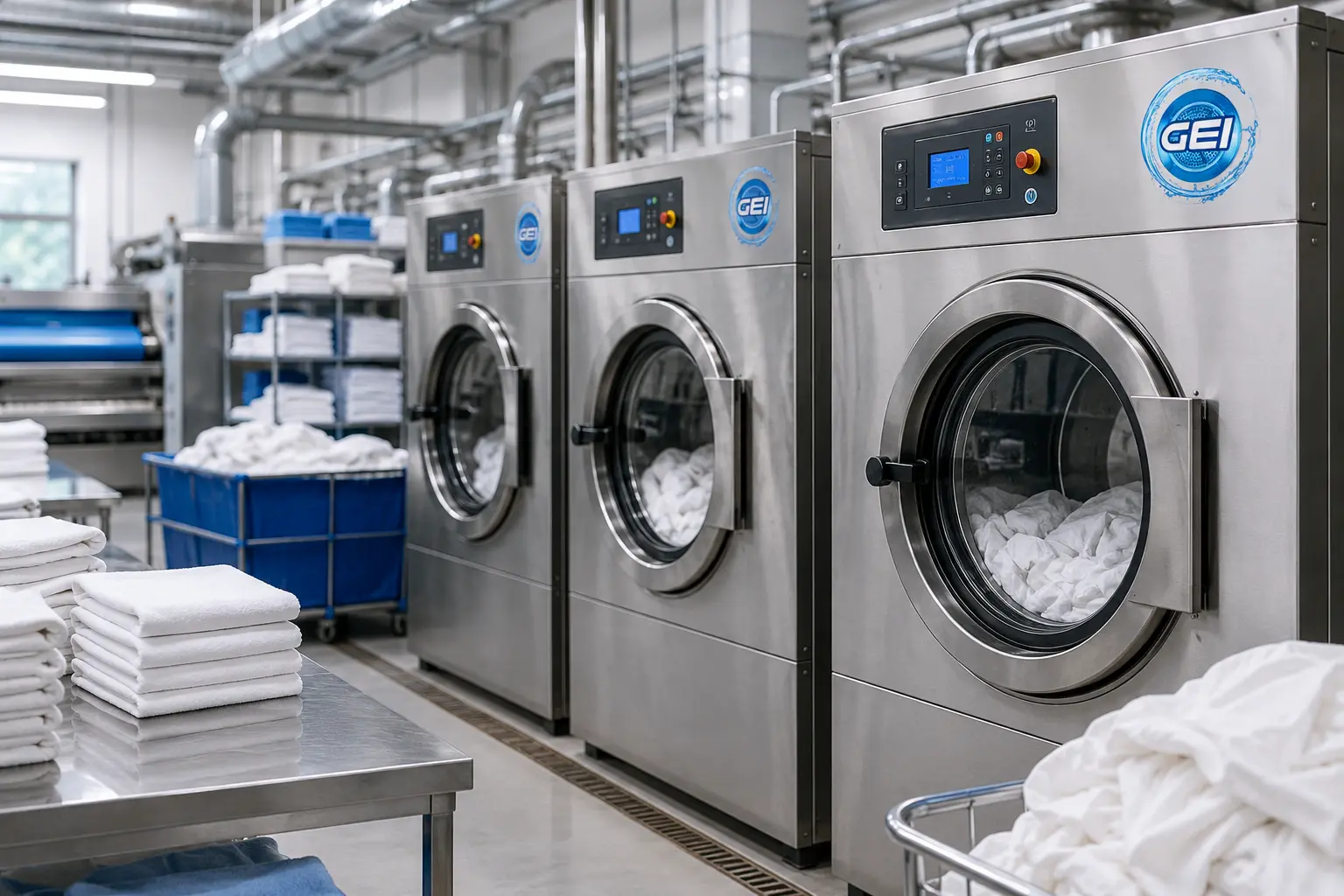
Buying laundry equipment for your business is the kind of decision that stays with you for 15 to 20 years. Get it right, and your operation runs smoothly, costs stay predictable, and the machines just work. Get it wrong — wrong machine, wrong supplier — and you're dealing with breakdowns, waiting weeks for spare parts, and calls that don't get answered. We've heard that second story a lot over four decades in this business.
This guide is written from a manufacturer's perspective. We'll tell you what to look for in the equipment, what questions to ask a supplier before signing anything, and how to avoid the mistakes that most buyers only discover after the purchase order is done. Whether you're setting up a new laundry or replacing ageing equipment, this is worth reading before you commit.
Introduction to Commercial Laundry Machines in India
India's organised laundry sector crossed USD 2.7 billion in 2025 and is on a growth trajectory driven by expanding hospitality, rising hygiene standards in healthcare, and a fast-growing urban laundromat segment. Every hotel, hospital, residential institution, and commercial laundry that grows past a certain volume eventually reaches the same point: manual washing can't keep up, and the economics of outsourcing stop making sense.
That's when a business starts looking for proper equipment. And that's when getting the supplier decision right really matters.
Why Commercial Laundry Machines Are in High Demand
The demand isn't coming from one sector. It's everywhere at once.
- New hotels opening in Tier 1 and Tier 2 cities need in-house laundry rooms from day one
- Hospitals facing stricter infection control mandates are replacing older equipment with machines that can run thermal disinfection cycles reliably
- Residential schools and hostels that used manual washing for years are hitting volumes where that's no longer feasible
- Urban laundromats are growing as a business category, creating buyers who didn't exist five years ago
Add to that the industrial push — garment exporters, food processing units, textile companies — and you understand why the market for laundry equipment suppliers keeps growing.
Types of Commercial Laundry Machines
Knowing what each machine category does helps you buy what your operation actually needs — not just what a supplier happens to have in stock.
Washer Extractors
The foundation of any serious laundry setup. A fully automatic washer extractor washes and spin-extracts in one drum, reducing drying time, lowering energy costs, and increasing throughput.
Programmable cycles handle everything from delicate fabrics to heavily soiled linen with minimal operator intervention.
Tumble Dryers
After extraction, linen still contains residual moisture. A properly sized tumble dryer ensures smooth workflow without bottlenecks between washing and finishing.
Available in both electric and gas-heated configurations to match your facility requirements.
Flatwork Ironers
Ideal for sheets, pillowcases, and table linen. Heated rollers iron and finish-dry items in a single pass for maximum efficiency.
Essential equipment for hotels, hospitals, and institutional laundries handling large linen volumes.
Vacuum Ironing Tables
Designed for garments such as uniforms, shirts, and formal wear that require careful pressing without fabric distortion.
Built-in suction holds garments flat during pressing, delivering a professional finish every time.
Spotting Machines
Removes stubborn stains before garments enter the main wash cycle using targeted steam, air, and solvent treatment.
Helps reduce rewash rates, saving water, energy, detergent, and valuable processing time.
Flatbed Presses
Perfect for larger flat garments and workwear where a wrinkle-free finish is required but roller ironing is not practical.
Commonly used in hotel finishing rooms and commercial garment processing departments.
Industries That Need Commercial Laundry Equipment
- Hotels: A mid-size property typically processes 80–150 kg of linen every day. In-house equipment almost always pays back faster than outsourcing, usually within 18 to 30 months at hotel volumes
- Hospitals: Patient linen, surgical covers, and staff clothing need washing at temperatures that meet hygiene standards. Continuous operation without breakdowns is non-negotiable
- Laundromats: Running cost per cycle and machine reliability determine whether the business model works. Both need to be right from day one
- Garment Industries: Pre-wash, sample wash, and finishing each require programmable cycle parameters that standard machines can't deliver
- Hostels & Residential Schools: High daily volume with minimal staff — the right machine combination handles it without needing a dedicated laundry team on shift all day
- Food Processing Units: Workwear hygiene is a regulatory requirement. Consistent high-temperature wash cycles, not approximations, are what the sector needs
Key Features to Look for in Commercial Laundry Machines
- Energy Efficiency: Ask for actual consumption data — litres of water per kg of linen, kWh per cycle. The difference between a well-engineered machine and a budget option adds up to lakhs over five years of daily operation
- Automation: Fully programmable digital controls eliminate human error, reduce the skill requirement for operating staff, and deliver consistent results across every load regardless of who's on shift
- Stainless Steel Build Quality: Grade 304 or 316 for the drum and all surfaces that contact wet linen. Anything else will corrode under continuous chemical and moisture exposure
- High Capacity Performance: Match machine capacity to your real average daily volume — not a theoretical peak. A machine running at half load wastes energy just as badly as an undersized machine creating backlogs
- Water Saving Technology: Modern fully automatic washer extractors use 10–12 litres per kg. Older or cheaper machines can use two to three times that — and water costs are rising in most Indian cities
- Easy Maintenance: Accessible components, clear service documentation, and locally available spare parts. A machine that needs specialist tools or international parts for routine servicing is a liability that will cost you more than you saved at purchase
How to Choose the Right Commercial Laundry Machine Supplier in India
The supplier decision matters as much as the machine decision. These are the questions worth asking before you commit:
-
Are they a manufacturer or just a distributor?
A manufacturer can customise equipment for your needs, provide direct engineering support when something breaks, and cut out the margin a distributor adds to every sale. Important when you need someone accountable after the purchase
-
How long have they operated continuously in India?
Not how long the brand has existed, but how long this specific entity has been selling and servicing equipment here. Suppliers who set up quickly tend to exit just as fast when margins get tight
-
Can they take you to see a working installation?
Any credible supplier should be able to show you similar machines operating at a client's facility. If they're reluctant to do this, that reluctance is telling you something
- What does after-sales support look like in practice?
Not 'we offer nationwide service.' Ask specifically: how many hours from a service call to a technician on-site? What's the spare parts lead time? Is there a structured service contract? These specifics reveal the real picture
- Do they assess your operation before quoting?
Your daily linen volume, facility layout, electrical load, and water supply all determine what equipment will actually work for you. A quote produced without understanding any of this is guesswork labelled as a recommendation
Benefits of Buying from Indian Commercial Laundry Machine Manufacturers
-
Service response in days, not weeks:
No dependency on foreign service centres or sparse distributor networks stretched thin
-
Spare parts available locally:
No international freight delays when a component needs replacing at short notice — and no customs paperwork holding up your repair
-
Machines built for Indian conditions:
Water hardness varies dramatically between Indian states. Voltage fluctuations are a real operating condition. Indian manufacturers who've been running for decades have designed their equipment around these realities. Most imported machines haven't
- No customs duty loading:
Commercial laundry equipment imported into India carries significant duty — this adds directly to the purchase price for no performance benefit
- Customisation is genuinely possible:
Specific capacity requirements, heating type preferences, programme settings for your linen type — a manufacturer can work with you on these. An importer of fixed-spec machines usually cannot
Commercial Laundry Machine Price Factors in India
Understanding what drives equipment pricing helps you evaluate quotes accurately, not just compare numbers:
| What Affects Price | Why It Matters to Your Decision |
|---|---|
| Machine category | Washer extractors, tumble dryers, and flatwork ironers are entirely different price brackets — comparing across types is meaningless |
| Drum capacity | Higher capacity costs more upfront but reduces cost-per-kg significantly over time — size to your real daily volume, not a peak |
| Automation level | Fully automatic digital-control machines cost more than basic models but the difference pays back quickly in lower labour costs and fewer errors |
| Country of manufacture | Imported equipment carries customs duty; Indian-manufactured machines don't — often a meaningful cost gap on equivalent specifications |
| Steel specification | Grade 304 vs 316 stainless, powder-coated outer panels — material choices affect lifespan, maintenance frequency, and long-term running cost |
| After-sales package | Installation, commissioning, operator training, and a service contract included is worth considerably more than a cheaper machine with no support |
Latest Trends in Industrial Laundry Equipment
-
Running cost as a primary buying criterion:
Buyers now ask for consumption data — litres per kg, kWh per cycle — before comparing machine prices. The conversation has shifted from purchase cost to total operating cost
-
Spare parts available locally:
No international freight delays when a component needs replacing at short notice — and no customs paperwork holding up your repair
-
Ozone wash systems:
Work effectively at lower water temperatures, cutting thermal energy use and chemical volumes simultaneously. GEI introduced ozone wash capability to its range in 2019
- Programmable wash profiles:
Different linen types, different programmes on the same machine — this protects fabric quality and extends linen working life significantly
- Reliability over connectivity:
After some enthusiasm for IoT-connected machines, operators are pulling back toward equipment that prioritises mechanical durability and straightforward local serviceability
Why GEI is One of the Trusted Commercial Laundry Machine Suppliers in India
GEI — Gupta Electrical Industries — has manufactured laundry equipment at its Peenya, Bengaluru facility since 1981. That's over four decades of building machines for Indian hotel laundries, hospital laundries, garment units, and institutional setups. We know what Indian water conditions do to equipment over time. We understand what local operators need from a machine day-to-day versus what sounds good in a spec sheet.
-
TÜV SÜD ISO certified:
Independent third-party quality certification, not a self-declared standard
-
100% Made in India:
Designed, fabricated, assembled, and tested at our Bengaluru plant — no re-badged imports
-
In-house R&D:
Our fully automatic washer extractor was developed through a decade of internal engineering specifically for Indian operating conditions
-
Ozone wash technology since 2019:
Energy savings, lower chemical use, effective hygiene results at reduced wash temperatures
-
Service coverage:
GEI engineers handle scheduled maintenance and breakdown support at client sites, with response times measured in days
Common Mistakes to Avoid While Buying Laundry Equipment
-
Leading with price.
The cheapest machine is almost never cheapest over five years once you account for running costs, maintenance, and downtime risk. Total cost of ownership is the right measure
-
Sizing for a theoretical peak.
Machines built for a maximum that happens twice a year run underloaded every other day. Design for your real average volume
-
Not investigating after-sales before buying.
The right time to discover a supplier has poor service response is before the sale — not when your machine is down during peak check-out
-
Choosing semi-automatic machines for all-day commercial use.
Semi-automatic equipment requires manual intervention between operational stages and isn't designed for continuous high-volume operation
-
Skipping a site assessment.
Electrical load, drainage configuration, floor space, water pressure — all of this affects which equipment can be installed. A supplier quoting without seeing your facility is making assumptions that may not hold
-
Not asking about spare parts.
Imported machines whose components need to be sourced internationally can sit broken for weeks. Ask this before you sign, not after
FAQs About Commercial Laundry Machines in India
Conclusion
Finding the right commercial laundry machine supplier in India comes down to choosing a partner that treats the relationship as long-term — one that asks the right questions before recommending equipment, installs it correctly, and remains available when support is needed after the sale.
GEI has operated that way since 1981. If you're evaluating laundry equipment for a new facility, expansion project, or equipment upgrade, get in touch with our team. A free capacity assessment costs nothing and could help you avoid investing in the wrong solution.