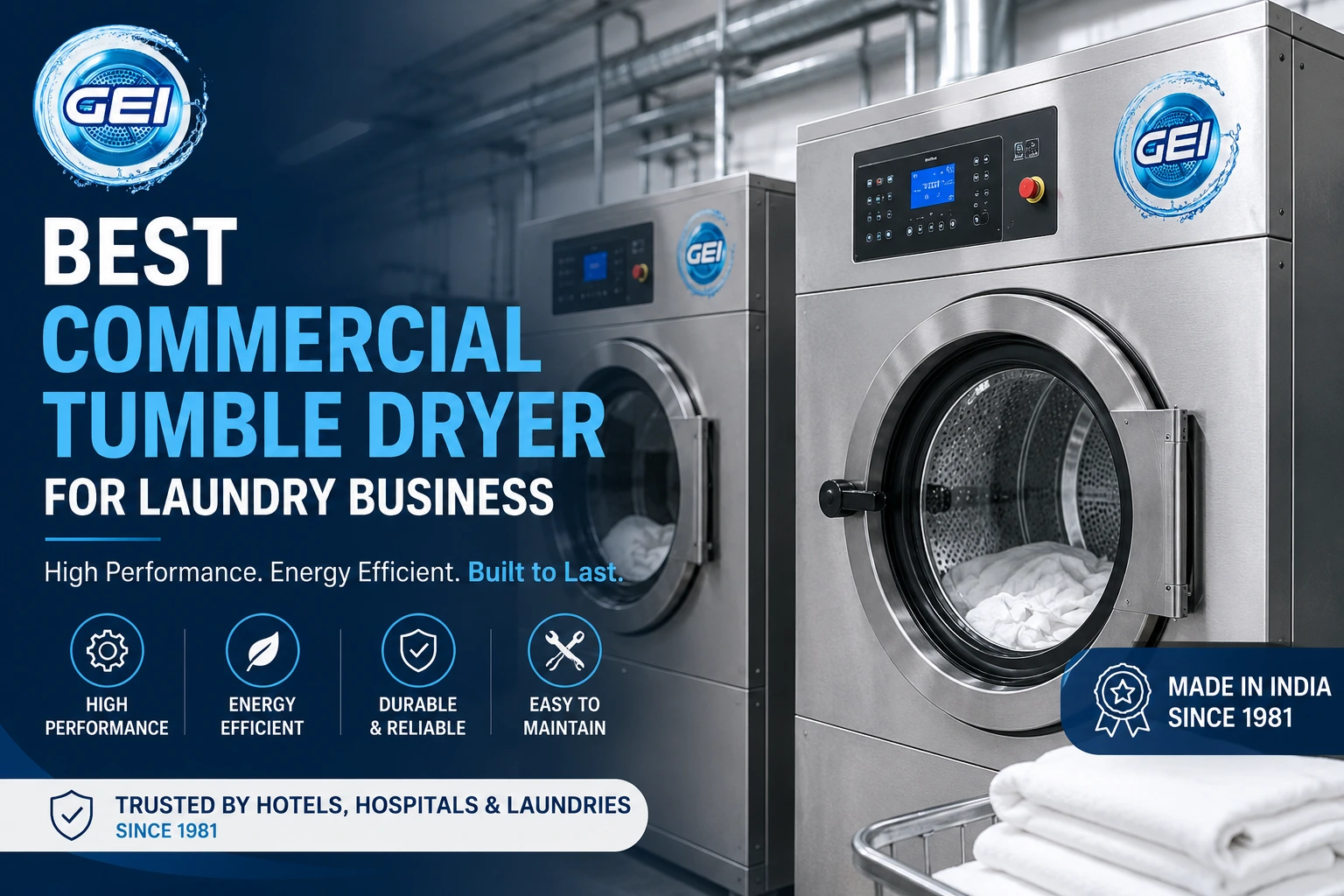
Introduction: Why Choosing the Right Commercial Tumble Dryer Matters
A tumble dryer sounds like a straightforward purchase. It dries clothes. How complicated can it be? The answer, unfortunately for buyers who've learned the hard way, is quite complicated. The wrong commercial tumble dryer for your operation will create bottlenecks, drive up your electricity bill, break down under continuous use, and take weeks to get serviced. The right one just quietly does its job, shift after shift, for fifteen years or more.
This guide covers what to look for in the best commercial tumble dryer for your laundry business — from key features to capacity sizing to the questions worth asking before you commit to a purchase.
What is a Commercial Tumble Dryer?
A commercial tumble dryer is a heavy-duty drying machine built for continuous operation in laundry businesses, hotels, hospitals, hostels, and any setting where linen needs to be processed in volume, day after day. Unlike domestic dryers designed for a few loads a week, commercial models are engineered to run multiple cycles daily — often 8 to 16 hours — without the mechanical stress that would destroy a household appliance in weeks.
They work by tumbling linen in a rotating drum while heated air circulates through it, carrying away moisture. Most commercial models use either electric heating elements or gas burners to generate the drying heat. The drum, the bearings, the heating system, and the controls are all built to industrial specification — meaning they're repairable, maintainable, and designed to last.
Difference Between Commercial and Residential Dryer Machines
| Factor | Commercial Dryer | Residential Dryer |
|---|---|---|
| Daily use | 8–16 hours, multiple cycles | A few loads per week |
| Drum capacity | 15 kg to 60 kg+ | 6–10 kg |
| Cycle time | 30–50 minutes | 60–90 minutes |
| Build | Stainless steel drum, industrial components | Coated drum, domestic parts |
| Serviceability | Designed for on-site repair and maintenance | Typically replaced when a component fails |
| Lifespan | 10–12 years with maintenance | 7–10 years |
Why Laundry Businesses Need Industrial Dryer Machines
If your business processes laundry commercially, a domestic dryer simply won't hold up — and it will cost you more in the long run if you try.
- Domestic machines aren't built for back-to-back cycles. Running them continuously causes overheating and premature component failure
- Their capacity is too small — a single hotel wash load will need three or four domestic dryer cycles, destroying your processing speed
- Cycle times are longer, which means less throughput per shift
- They're not designed to be maintained in place — when something goes wrong, the economics of repair often don't work out
For any business processing more than 20 kg of laundry daily, a proper industrial dryer machine is the only sensible choice. The operating economics just don't work any other way.
Key Features to Look for in a Commercial Tumble Dryer
Choosing the right tumble dryer isn't just about capacity. The right features improve efficiency, reduce operating costs, extend linen life, and ensure smooth daily operations.
Drying Capacity
Match the dryer's capacity to your washer extractor output. A common mistake is buying a dryer that's smaller than the washer — linen queues up between the two machines, and you lose hours every shift. A dryer should be able to accept and process a full washer load without delay.
Energy Efficiency
Dryers are energy-hungry machines. Ask for kWh per cycle data, not just the heating element's rated wattage. Gas-heated dryers typically cost significantly less to run than electric models where natural gas is available — the running cost difference over five years can be substantial at commercial volumes.
Drying Speed
Cycle time directly determines how much laundry your operation can process in a shift. A dryer with a 35-minute cycle processes roughly 40% more volume per day than one taking 50 minutes — same machine, same electricity, more throughput. Ask for actual cycle time data under standard load conditions.
Drum Material & Durability
Stainless steel drum — ideally Grade 304 or better. The drum surface contacts wet linen, detergent residue, and fabric softeners in every cycle. Anything that corrodes will transfer rust and contamination to your linen. Stainless steel doesn't corrode and doesn't need replacing within the machine's lifespan.
Automatic Moisture Sensors
Moisture sensors stop the drying cycle when linen reaches the target dryness level rather than running for a fixed time. This prevents over-drying — which damages fabric and wastes energy — and under-drying, which sends linen to the ironing stage still damp. On high-volume operations, sensor-controlled drying saves meaningful electricity costs over time.
Digital Control Panels
Programmable digital controls let you set specific drying parameters for different linen types — lower temperatures for delicates, higher heat for towels and workwear. This protects your linen quality and extends garment life. Digital panels also make it easier to train staff and monitor cycle consistency.
Safety Features
Look for automatic overheating cutoff, lint filter clog alerts, and door interlock systems that prevent the drum from operating with the door open. These aren't optional extras — they're standard requirements for a machine running 8+ hours daily.
Low Maintenance Design
Accessible lint filters, serviceable bearings, replaceable heating elements — these design characteristics determine how easy and affordable the machine is to maintain over its lifespan. A machine with inaccessible components or non-standard parts will accumulate deferred maintenance, and deferred maintenance means breakdowns at inconvenient times.
Types of Commercial Tumble Dryers
- Electric tumble dryers: Heated by electric elements. Higher running cost than gas but no gas infrastructure requirement. Suitable for facilities where LPG or natural gas connections aren't available
- Gas tumble dryers: Heated by LPG or natural gas burners. Significantly lower operating cost than electric in most Indian markets. Requires proper ventilation and gas connection but often the better long-term economics
- Steam-heated dryers: Used in operations where a central steam boiler is already running. Efficient where the infrastructure exists, but not practical as a standalone setup
Best Commercial Tumble Dryer Options for Laundry Businesses
Small Laundry Shops
For a laundry startup or small neighbourhood laundry, a 15–20 kg dryer paired with a matching washer extractor handles daily volumes without oversizing the investment. Electric models work well at this scale where gas connections may not be available.
Medium-Scale Laundry Businesses
Operations processing 50–100 kg daily need 30 kg capacity dryers, potentially running multiple units. At this scale, gas heating starts paying off meaningfully in running cost terms and the investment in proper ventilation infrastructure makes sense.
Industrial Laundry Operations
Large-scale commercial laundries processing 200 kg or more daily typically run multiple 50 kg+ dryers in parallel. Reliability and service support become the primary selection criteria at this scale — downtime costs are significant when machines are processing this volume continuously.
Hotels & Hospitals
Hotels need dryers that match their washer extractor output exactly and can run across multiple shifts without maintenance issues. Hospitals need machines that handle linen at the right temperatures for hygiene requirements. In both cases, after-sales support quality matters as much as machine specification.
Commercial Tumble Dryer Capacity Guide
Note to GEI team: Please verify that the capacity ranges below match your current product offerings before publishing.
-
15 kg dryer
Suited to small laundry setups, guesthouses, and hostels processing moderate daily volumes. Compact footprint, lower investment
-
30 kg industrial dryer:
The most common capacity for mid-size hotel laundries and commercial laundromats. Balances throughput with investment cost
-
50 kg clothes dryer machine:
For high-volume hotel laundries, large hospital setups, and commercial laundries handling significant daily linen
- 60 kg and above:
Large-scale industrial laundry operations processing several hundred kilograms daily, often running multiple units in parallel
Commercial Tumble Dryer vs Industrial Dryer Machine: Which One Should You Choose?
The terms are often used interchangeably, and the distinction is largely one of scale. 'Commercial tumble dryers' typically refer to machines in the 15–50 kg range suited to hotels, laundromats, hospitals, and mid-size operations. 'Industrial dryer machines' usually implies higher capacity units for large-scale laundry plants processing several hundred kilograms daily.
For most laundry businesses, hotels, and hospitals in India, a commercial tumble dryer in the 15–50 kg range will cover the requirement. True industrial-scale machines are only necessary when daily volumes run into hundreds of kilograms processed in a continuous workflow.
Important Factors Before Buying a Clothes Dryer Machine
Laundry Volume
Calculate your average daily drying requirement in kilograms, then select a dryer that can handle that volume across your operating shifts without running at maximum capacity all day. Leaving 20–25% headroom protects the machine and allows for volume fluctuations.
Space Requirements
Dryers need clearance around them for door opening, service access, and ventilation. Measure your available space carefully before selecting a machine — and factor in the space needed for linen trolleys to manoeuvre around the equipment.
Power Consumption
A commercial dryer is one of the most power-intensive machines in a laundry setup. Check that your facility's electrical supply can handle the load — particularly if you're running multiple machines. Gas-heated models significantly reduce the electrical demand.
Ventilation Needs
Vented dryers need a clear exhaust path to the outside. This needs to be factored into the facility layout before installation — retrofitting ventilation after the machine is in place is expensive and sometimes impossible without structural work.
Budget Planning
Budget for the machine purchase, installation, ventilation work if needed, and a service contract. The total cost of getting a dryer properly operational is typically 15–25% more than the machine price alone.
After-Sales Service
A dryer breakdown during peak operating hours is expensive. Before purchasing any machine, understand clearly: who services it, how long a call-out takes, and whether genuine parts are available locally or need to be imported.
Energy Efficiency & Cost Savings in Modern Dryer Machines
Modern commercial tumble dryers have improved considerably in energy efficiency over the last decade. Key developments that affect operating cost:
- Moisture sensor technology ends cycles automatically at target dryness — eliminating the energy wasted by fixed-time programmes that run regardless of whether linen is actually dry
- Improved insulation on drum and housing reduces heat loss during cycles
- Variable heat settings allow lower temperatures for linen types that don't need full heat — extending fabric life and reducing energy use
- Gas heating offers substantially lower running cost than electric at equivalent performance — where gas is available, this is often the most impactful efficiency decision
Common Problems in Commercial Dryer Machines & How to Avoid Them
Overheating
Caused by blocked lint filters, inadequate ventilation, or a faulty thermal cutoff. Clean lint filters after every cycle, ensure exhaust ducting is clear, and schedule regular thermal system checks.
Longer Drying Cycles
Usually caused by overloading the drum, worn drum seals allowing heat to escape, blocked exhaust ducting, or a failing heating element. Follow manufacturer load recommendations and schedule annual servicing.
Maintenance Issues
Deferred maintenance is the most common cause of commercial dryer failures. Schedule preventive maintenance every six months regardless of whether the machine appears to be running well. Bearings, belts, heating elements, and seals all have service intervals that should be followed.
High Electricity Consumption
Often caused by over-drying (running cycles longer than necessary), undersized machines being overloaded and running extended cycles, or an aging heating system losing efficiency. Moisture sensors and proper sizing both address this directly.
How Proper Dryer Maintenance Improves Machine Lifespan
-
Clean lint filters after every cycle:
A blocked filter reduces airflow, extends drying time, increases energy use, and causes overheating — all preventable with a 30-second task
-
Check and clear exhaust ducting quarterly:
Lint buildup in ducting is a fire risk and a performance issue
-
Inspect drum seals annually:
Worn seals allow heat to escape, extending cycle times and increasing energy consumption
-
Schedule preventive maintenance every six months:
Bearings, belts, and heating elements caught early are inexpensive to replace. The same components failed during operation are expensive breakdowns
-
Keep a service log:
Record every maintenance visit, part replacement, and issue noted. This helps identify patterns before they become failures
Best Industries That Need Commercial Tumble Dryers
-
Laundry Businesses:
Throughput speed determines revenue capacity — a faster, reliable dryer directly affects how many loads you can process per shift
-
Hotels:
Towels, robes, and bed linen in continuous rotation need drying that keeps pace with the hotel's check-in and check-out cycle
-
Hospitals:
Patient linen needs to be processed quickly and at appropriate temperatures for hygiene. Dryer reliability is critical in clinical environments
-
Hostels:
High volume, cost sensitivity, and minimal staff make a reliable, easy-to-operate dryer essential for hostel management
-
Textile Industries:
Fabric finishing and pre-treatment processes often require controlled drying conditions that consumer-grade equipment can't deliver
-
Dry Cleaning Businesses:
Garments returning from solvent cleaning need careful drying at controlled temperatures to restore fabric condition without damage
How to Choose the Best Commercial Tumble Dryer Supplier in India
-
Manufacturer or distributor?
A manufacturer can modify specifications, support the machine directly, and price without a distribution margin
-
Do they manufacture specifically for Indian conditions?
Voltage specifications, water quality effects on components, and local climate all affect machine design. Indian manufacturers who've been operating for years have solved these problems
-
What's their actual service response time?
Ask for a specific commitment — hours from a call to a technician on-site — not just 'we offer after-sales service'
-
Can you see their machines running somewhere?
Seeing a dryer in operation at a client site tells you far more than any brochure
-
Are spare parts available locally?
For an imported machine, this question is especially important — parts sourced internationally can take weeks to arrive
Why GEI (Laundry Machine India) is a Trusted Choice for Commercial Laundry Equipment
With over four decades of manufacturing experience, GEI has become one of India's most trusted names in commercial laundry equipment. Built for reliability, efficiency, and long-term performance, our machines are designed to meet the demands of modern laundry operations across hotels, hospitals, laundromats, institutions, and industrial facilities.
Built for Indian Laundry Operations
Operating as Laundry Machine India through laundrymachine.co.in, GEI manufactures commercial laundry equipment at its Bengaluru facility. Our tumble dryers are engineered to withstand continuous daily use, diverse fabric types, and demanding commercial environments where reliability is critical.
TÜV SÜD ISO Certified
Independently verified manufacturing standards and quality processes.
Made in India
Designed and manufactured at our Peenya Industrial Area facility in Bengaluru.
Complete Laundry Solutions
From washer extractors and tumble dryers to flatwork ironers and finishing equipment.
Dedicated Service Support
Installation assistance, preventive maintenance, and responsive breakdown support.
Installation & Maintenance Tips for Industrial Dryer Machines
- Ensure the installation site has adequate electrical capacity — check with your electrician before delivery
- Plan exhaust ducting before the machine arrives — retrofitting is expensive
- Level the machine properly during installation — vibration from an unlevel machine accelerates bearing wear
- Train all operators on lint filter cleaning before the machine goes into service
- Set up a preventive maintenance schedule from day one, not after the first breakdown
- Keep a small stock of common consumables — lint filters, door seals — so routine maintenance doesn't require waiting for parts
Need Laundry Equipment for Your Business?
GEI has been building laundry machines for Indian businesses since 1981. Get in touch for a free capacity assessment and quote.
FAQs About Commercial Laundry Machines in India
Final Thoughts: Choosing the Right Clothes Dryer Machine for Your Business
The best commercial tumble dryer for your laundry business is the one that matches your actual daily volume, fits your facility, runs on the power source that makes economic sense for you, and comes from a supplier who'll service it reliably for the next fifteen years.
Don't buy on price alone. Don't buy on spec sheet alone. Ask to see the machine running somewhere, ask specifically about service coverage in your area, and get real consumption data before comparing costs.
GEI has supplied and maintained commercial laundry equipment for businesses across India since 1981. If you're evaluating tumble dryers for your laundry setup, our team can help you make the right choice from the start.
Related Resources
Explore our commercial laundry equipment range and learn more about the industry.