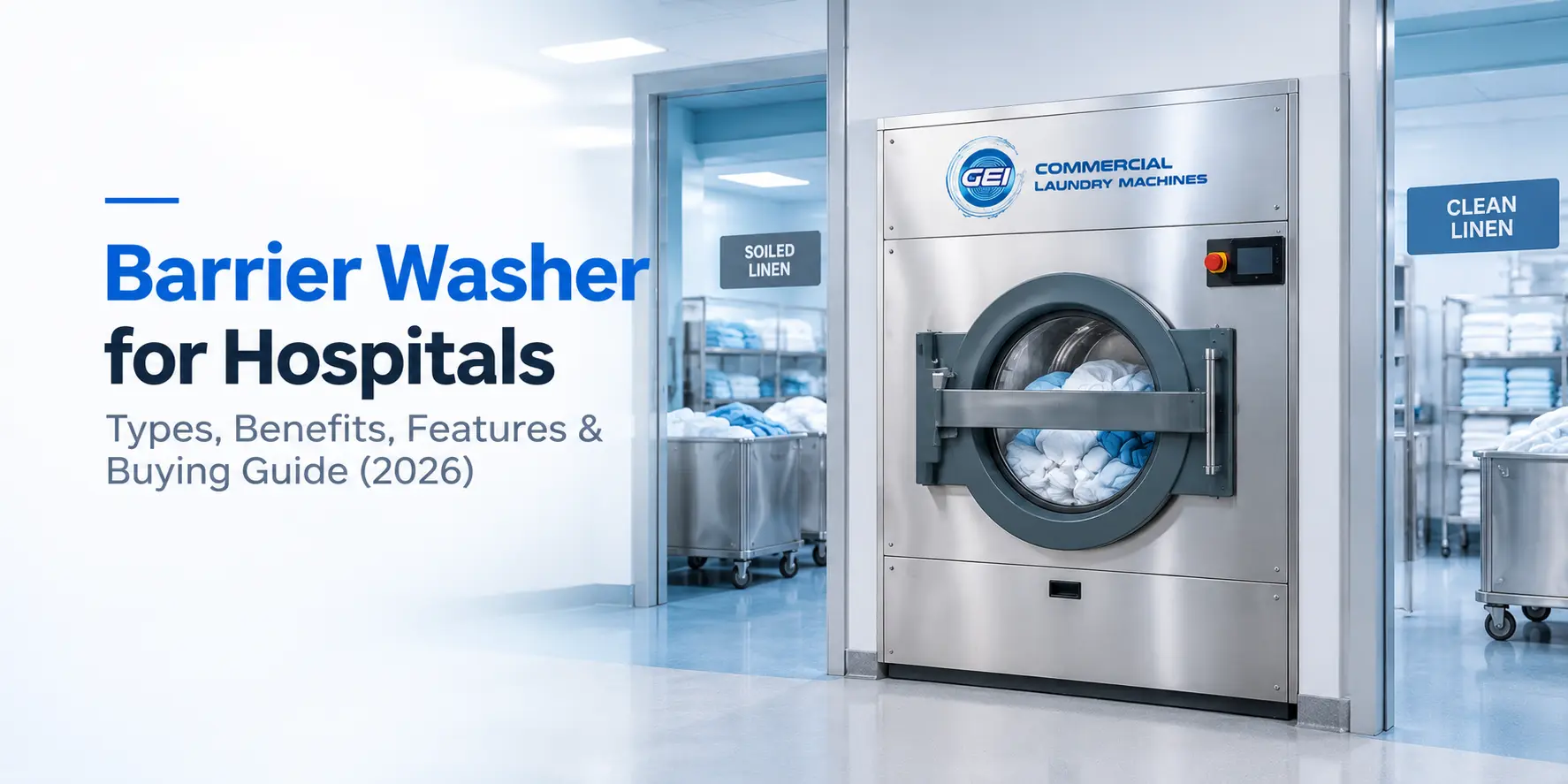
Hospital laundry carries a risk that ordinary commercial laundry doesn't: cross-contamination between soiled and clean linen. A barrier washer for hospitals is built specifically to remove that risk, physically separating the dirty-linen side of the room from the clean-linen side while a single machine handles the wash. This guide explains what these machines are, the main types available, the features that matter most, and how to choose the right one for your facility's laundry volume and infection-control requirements. It also covers how these machines differ from a conventional industrial washer, since that distinction matters far more in a clinical setting than it does in a hotel or laundromat.
What Is a Barrier Washer for Hospitals?
A barrier washer for hospitals is a washing machine built into a wall or partition, with a loading door on the contaminated side and a separate unloading door on the clean side. Soiled linen goes in from the dirty-linen area, and washed linen comes out into the clean-linen area, with no path for the two to cross. This physical separation is central to hospital infection-control practices, since it prevents staff, air, and surfaces on the clean side from ever coming into contact with unwashed linen. Many facilities pair the machine with interlocked doors, so the dirty and clean sides can never be opened at the same time, reinforcing the barrier mechanically rather than relying on staff discipline alone.
Types of Barrier Washers
◆ Single-Door Barrier Washer
A more compact configuration that still separates load and unload sides, suited to smaller hospitals or facilities with tighter space and lower volume. It still delivers the core infection-control benefit of a barrier washer, just at a scale that fits a smaller laundry room.
◆ Double-Door Barrier Washer
The standard hospital configuration, with a fully sealed wall between the dirty and clean sides and separate doors for each, built for consistent daily infection-control use. It's the configuration most large hospitals default to, since it balances reliable separation with manageable installation requirements.
◆ Fully Automatic Barrier Washer
Adds programmable wash cycles and automated controls on top of the barrier design, reducing manual intervention and keeping results consistent across high-volume hospital laundries. This configuration suits facilities that run laundry around the clock and cannot afford variation in wash quality between shifts.
| Type | Design | Operation | Suitable Hospital Applications |
|---|---|---|---|
| Single-door | Compact barrier, one main access point | Manual to semi-automatic | Smaller hospitals, clinics |
| Double-door | Full wall separation, two doors | Manual to fully automatic | General hospital laundries |
| Fully automatic | Full wall separation, programmable controls | Automated wash programs | High-volume hospital laundries |
Benefits of Using a Barrier Washer in Hospitals
◆ Helps Separate Clean and Dirty Areas
The physical wall between load and unload sides keeps contaminated and clean zones distinct at all times. Staff working the dirty side never need to enter the clean side, which removes one of the most common ways contamination spreads in a busy laundry room.
◆ Supports Hygiene and Infection Control
Barrier washing is a recognised part of hospital infection-control practice, reducing the chance of pathogens travelling with unwashed linen. Many accreditation bodies and hospital infection-control policies specifically call for this kind of physical separation in facilities processing significant volumes of soiled linen.
◆ Improves Laundry Workflow
A clear one-way flow from dirty to clean keeps staff movement logical and reduces confusion during busy shifts. New staff can be trained on the process quickly, since the layout itself enforces the correct sequence of handling.
◆ Reduces Cross-Contamination Risk
Separating the two sides removes the main pathway by which soiled linen could contaminate clean linen or staff.
◆ Handles High-Volume Hospital Laundry
Commercial-grade construction and larger capacities keep pace with the continuous laundry demands of a busy hospital. This matters particularly for hospitals that cannot afford a backlog of soiled linen building up in wards or storage areas.
Key Features to Look for in a Barrier Washer
◆ Washing Capacity
Capacity should be matched to your hospital's daily linen volume, with headroom for peak periods. Hospitals often see spikes around surgical schedules or seasonal illness, so headroom above average daily volume is worth planning for from the outset.
◆ Programmable Wash Cycles
Different linen types, from bedding to surgical gowns, often need different wash programs, temperatures, and disinfection cycles. Having these presets built in reduces the risk of a wash cycle being shortened or run at the wrong temperature by mistake.
◆ Automated Controls
Automation reduces manual handling and keeps wash quality consistent regardless of which staff member is operating the machine. This is particularly valuable in facilities with rotating shifts and varying staff experience levels.
◆ Safety Features
Interlocked doors that prevent both sides opening at once are essential to maintaining the barrier and protecting staff. Look for machines with clear indicator lights or alarms that flag if a door is left improperly sealed.
◆ Water and Energy Efficiency
Efficient cycles reduce two of the largest recurring costs in a hospital laundry: water and energy. Over the lifetime of the machine, these savings often outweigh a modest difference in purchase price between models.
◆ Easy Maintenance and Service Support
Responsive servicing and available spare parts are critical, since hospital laundry rarely has room for extended downtime. A facility that cannot pause laundry for more than a day or two should treat service response time as a core buying criterion, not an afterthought.
| Feature | Importance for Hospital Laundry Operations |
|---|---|
| Washing capacity | Prevents bottlenecks during peak linen volume |
| Programmable wash cycles | Supports correct disinfection for different linen types |
| Automated controls | Keeps results consistent across shifts and staff |
| Safety features | Maintains the barrier and protects operating staff |
| Water and energy efficiency | Controls two of the largest running costs |
| Maintenance and service support | Minimises downtime in a facility that cannot pause laundry |
How to Choose the Right Barrier Washer for a Hospital
- Determine daily laundry volume: base sizing on your busiest day, not an average one.
- Choose the appropriate capacity: match washing capacity to volume, with room to grow as the facility expands.
- Consider available space and installation requirements: barrier washers need a wall or partition with two access points, so plan the layout early.
- Evaluate automation and wash programs: check that programmable cycles cover the linen types and disinfection standards your facility needs.
- Consider long-term operating and maintenance costs: water, energy, and servicing shape the real cost of ownership far more than the purchase price alone.
| Hospital Size / Laundry Volume | Suitable Machine Capacity |
|---|---|
| Small hospital or clinic, low daily volume | Confirm from catalog (compact single-door) |
| Mid-size hospital, moderate daily volume | Confirm from catalog (medium double-door) |
| Large hospital, high continuous volume | Confirm from catalog (high-capacity, fully automatic) |
Barrier Washer vs Conventional Industrial Washing Machine
A conventional industrial washing machine loads and unloads from the same side, which works well for general commercial laundry but creates a real infection-control gap in a hospital setting. A barrier washer for hospitals closes that gap by physically separating the dirty and clean sides, so contaminated linen never shares a space with washed linen, staff, or air on the clean side. For hospitals, clinics, and other healthcare facilities, that separation makes a barrier washer the appropriate choice, while a conventional industrial machine remains suited to hotels, laundromats, and other non-clinical commercial laundries. The workflow difference also affects staffing: barrier washers require dedicated dirty-side and clean-side roles, which some facilities need to plan into their laundry staffing model before installation.
Common Mistakes to Avoid When Buying a Barrier Washer
- Choosing the wrong capacity: undersizing creates a bottleneck during peak demand, while oversizing wastes water and energy on part-loads.
- Focusing only on purchase price: the cheapest machine on offer is rarely the cheapest to run or maintain over its lifetime.
- Ignoring installation requirements: barrier washers need proper wall integration, so overlooking this at the planning stage causes costly delays. Involve your facilities or maintenance team early, since retrofitting a wall-mounted barrier washer into an existing laundry room is far more disruptive than planning for it during a renovation or new build.
- Not checking service and spare-parts availability: a facility that cannot pause laundry needs a supplier who can respond quickly when something needs fixing.
These four issues account for the majority of problems hospitals report after installing a barrier washer, and each one is straightforward to avoid with proper planning before the purchase is finalised.
Frequently Asked Questions
Choose the Right Barrier Washer for Hospitals with LaundryMachine.co.in
geilaundry.com works with hospitals and healthcare facilities to specify barrier washers suited to their exact laundry volume and infection-control requirements. Machine selection should always be based on your facility's daily linen volume, space, and wash program needs rather than a one-size-fits-all recommendation, and the team can advise on installation planning alongside the machine itself. Pair your barrier washer with the right commercial tumble dryers and browse the full commercial laundry equipment range on geilaundry.com to complete your hospital laundry setup. For broader guidance on healthcare-associated infection control, the World Health Organization publishes independent reference material worth reviewing.