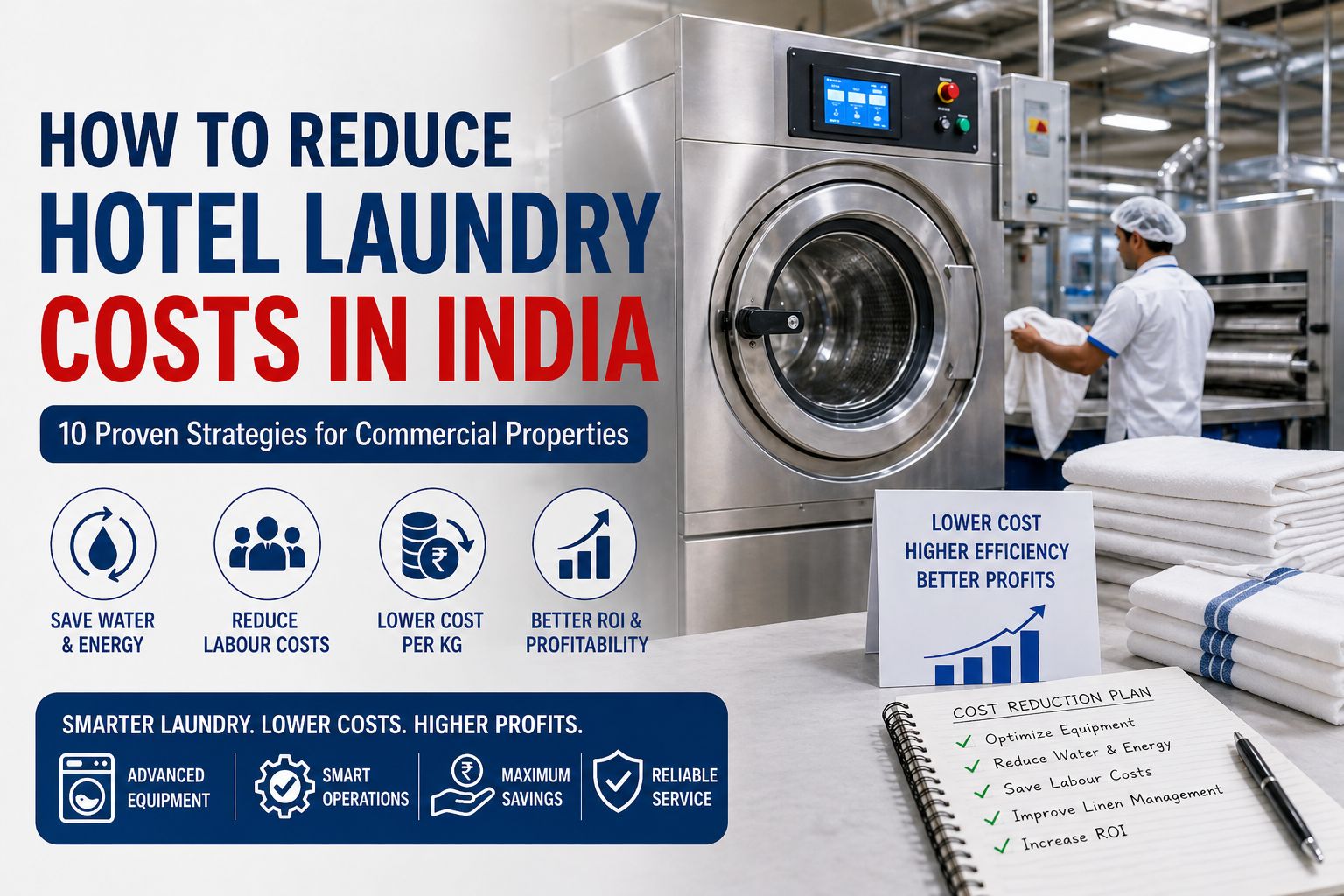
Laundry is one of the highest recurring costs in Indian hotels — consuming 5–15% of a property's total operating budget. Rising electricity tariffs, water costs, and labour wages across Bengaluru, Mumbai, and Delhi make finding smart hotel laundry cost reduction strategies an operational priority, not an afterthought. In this guide, GEI — India's commercial laundry equipment manufacturer since 1981 — shares 10 proven strategies that hotels across the country are using to reduce laundry expenses without compromising linen quality or guest experience.
The True Cost of Hotel Laundry in India
Before cutting costs, you need to see them clearly. Indian hotels typically spend ₹25–₹55 per kilogram on outsourced laundry. Even for a modest 100-room property at 70% occupancy, this translates to ₹15,000–₹40,000 per month in laundry alone. Hotels processing more than 150 kg of linen per day almost always find that in-house laundry delivers a 30–50% saving over outsourcing once the right equipment is in place.
The good news: most of the biggest savings come from a combination of the right commercial laundry equipment and simple operational discipline — both of which are entirely within your control.
10 Strategies to Cut Hotel Laundry Costs
EQUIPMENT STRATEGIES
1. Upgrade to a Fully Automatic Washer Extractor
The single most impactful change most Indian hotels can make is replacing older or outsourced washing with a fully automatic washer extractor. Modern washer extractors use 40–60% less water per kilogram than older alternatives, and their high G-force spin extraction removes significantly more water before drying — directly cutting tumble dryer energy consumption and cycle time. GEI's in-house developed washer extractors are built for continuous hotel use and come with programmable multi-cycle control.
View GEI Washer Extractor Range →
2. Match Tumble Dryer Capacity to Washer Output
An undersized dryer creates shift bottlenecks and forces overtime wages. An oversized one wastes energy on partial loads. GEI's energy-efficient tumble dryers are designed to pair with specific washer extractor outputs, ensuring smooth throughput and optimal energy use. Our team can calculate the right dryer-to-washer ratio for your occupancy patterns.
3. Use a Flat Work Ironer for Bed and Table Linen
Hand ironing large volumes of sheets, pillowcases, and tablecloths is the most labour-intensive part of any hotel laundry. A flat work ironer processes linen 5–8x faster than hand pressing and delivers a consistently professional finish. For most hotels, this single machine pays for itself in labour savings within 12–18 months.
4. Add a Spotting Machine to Reduce Rewashing
Heavily stained items (food, grease, blood) that go through the main wash without pre-treatment often need to be rewashed — doubling their cost. A spotting machine removes tough stains before the main wash cycle, reducing rewash rates by 15–25% in most hotel laundries.
OPERATIONAL STRATEGIES
5. Always Run Full Machine Loads
A washer extractor running at 90–100% of its rated capacity is dramatically more efficient per kilogram than one at 50–60%. Implement a batch management protocol — group linen by type and delay smaller batches until a full load is ready. This single discipline can reduce water, chemical, and energy costs by 20–30% without any capital investment.
6. Implement a Guest Linen Reuse Policy
A simple linen reuse programme — offering towel and sheet changes every 2–3 nights for long-stay guests, framed as an eco-friendly initiative — can cut wash cycles by 20–30%. Sustainability messaging resonates positively with modern travellers and costs nothing to implement. Most Indian business hotels with average 1–2 night stays find the highest impact with towel-only reuse policies.
7. Track and Plug Linen Loss
Indian hotels typically lose 3–10% of their linen inventory annually to theft, damage, and write-offs — a significant invisible cost. Implement a simple count-and-record system or RFID tagging for high-value items. Regular monthly audits create staff accountability and immediately surface loss hotspots.
8. Use Chemistry Matched to Your Water Type
India's water hardness varies enormously — from soft water in coastal Karnataka to very hard water in Rajasthan and Haryana. Using the wrong detergent for your water type results in poor wash quality, increased rewashing, scale damage to machines, and shorter linen life. Work with a commercial laundry chemical specialist who will test your water and match products accordingly. This alone can cut chemical spend by 15–20%.
9. Follow a Preventive Maintenance Schedule
A single commercial laundry machine breakdown during peak occupancy can cost ₹20,000–₹60,000 per day in emergency outsourcing. GEI provides scheduled after-sales service and maintenance support across India. A consistent preventive maintenance routine prevents 80% of unplanned breakdowns and extends machine life by 4–6 years.
10. Measure Your Laundry KPIs Monthly
You cannot reduce what you don't measure. Track these four numbers every month: cost per kg washed, water litres per kg, machine utilisation rate, and labour hours per 100 kg. Hotels that begin measuring consistently find 15–25% cost reduction opportunities within the first quarter.
Get a Free GEI Equipment Consultation for Your Hotel
Call: 9980803803 | 9611209756 | 9980880558
FAQs — Hotel Laundry Cost Reduction
Get answers to common questions about hotel laundry cost reduction, commercial laundry equipment, and operational strategies for Indian hotels.
Indian hotels typically spend ₹40–₹120 per occupied room per night on laundry, depending on star category and linen change frequency. Luxury properties with high linen standards can spend significantly more. Tracking this figure monthly is the first step toward reducing it.
For most 3-star hotels (50–150 rooms), a fully automatic washer extractor, a matched tumble dryer, and a flat work ironer form the core setup. A spotting machine for pre-treatment and a vacuum ironing table for uniforms round out a complete operation. GEI can design a full turnkey laundry room based on your room count.
Modern fully automatic washer extractors use 12–18 litres per kilogram of linen, compared to 30–50 litres in older equipment. Over a year of daily operations, this difference translates into significant water and heating cost savings, particularly relevant in Indian cities with rising water tariffs.
Most hotels with 80+ rooms processing 100+ kg/day see full capital cost recovery in 18–36 months. The break-even depends on your current outsourcing rate, machine utilisation, and local utility costs. GEI offers free ROI modelling — contact us for a projection tailored to your property.
A general rule of thumb is 0.5–0.8 kg of linen per occupied room per night across towels, bed linen, and F&B linen. For a 100-room hotel at 70% occupancy, you'll process approximately 35–56 kg per night. GEI can size your complete equipment configuration based on your actual linen data.
Yes. Strategies 5, 6, 7, 8, and 10 from this guide require no capital investment. Load optimisation, linen reuse policies, loss tracking, correct chemical selection, and KPI measurement can deliver 10–20% cost savings even with existing equipment. The largest gains, however, come from combining operational discipline with the right equipment.
A flat work ironer feeds sheets, pillowcases, and tablecloths through heated rollers at high speed — simultaneously ironing and completing the drying process. It replaces multiple staff doing hand ironing, reduces labour cost per piece by 60–70%, and delivers a professional finish that hand ironing cannot match at scale.
Yes. GEI has provided after-sales support since 1981, with service engineers available across India for scheduled maintenance, emergency breakdown response, and genuine spare parts supply. Call 9980803803 | 9611209756 | 9980880558 or team@geilaundry.com to schedule a service visit.